
Nusa Lembongan Map
Your travel map to Nusa Lembongan Island

Planning a trip to Nusa Lembongan? Start with the map, choose the part of the island that suits your stay, and leave room for the ocean to set the pace.
This Nusa Lembongan map and travel guide brings together our favourite places to explore, ways to get around, boat-planning tips and practical advice for your stay. Nusa Ceningan is linked by the Yellow Bridge; Nusa Penida is a separate boat trip. They are neighbouring islands, but visiting all three is not the same as exploring Lembongan for an afternoon.
For a first visit, we recommend at least three nights if your schedule allows. That gives you time for surfing, snorkeling or a freediving course, plus an unhurried look around. It also gives you more flexibility if sea conditions change your plans.
Choose your accommodation area, confirm the boat’s actual landing point, and book your main water activity before filling every spare hour. A ferry arrival time is not your hotel arrival time.
5 tips to prepare your trip
1 – Download your Nusa Lembongan map
Use our illustrated map of Nusa Lembongan and Nusa Ceningan to understand the islands’ layout and group nearby stops together. Open the full image to zoom in, or save it to your phone before heading out.
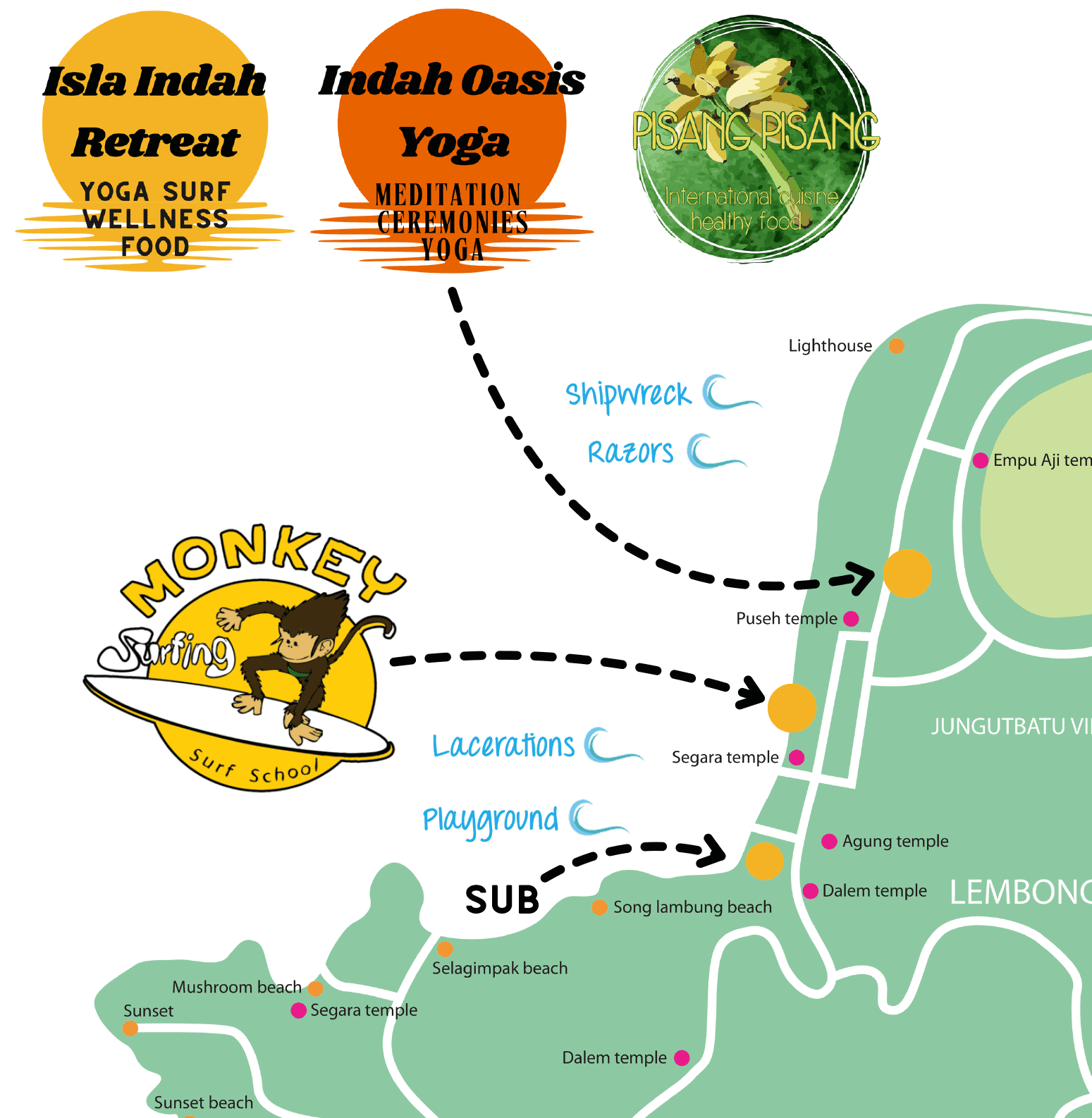
Open the full Nusa Lembongan map — then use your browser’s save-image option for an offline copy.
Choose your base before planning your route
- Jungutbatu: a useful base for beach time, surf-school arrangements and access towards the mangrove area. For a stay here, explore Isla Indah Retreat’s accommodation options.
- Mushroom Bay and the southwest: convenient for combining Mushroom Beach, Dream Beach, Sandy Bay and Devil’s Tears.
- Nusa Ceningan: cross the Yellow Bridge for coastal viewpoints and a different perspective on the islands. Allow time to return to your accommodation or confirmed boat departure point.
2 – Visit these 14 places of interest
Keep a few stops together rather than racing around every pin. The places below preserve the landmarks from our original guide, with updated planning advice. The official Indonesia Tourism guide to the Nusa islands is another useful introduction to the area.
Mangrove
Head towards the island’s northeast for the mangrove forest. A local guided boat outing offers a quieter way to explore its waterways. Offshore snorkeling is a separate activity: ask your operator which sites suit the conditions that day.
Dream Beach
Come for the sandy cove and ocean views, then pair it with nearby Devil’s Tears. Breaking waves and currents can make the water hazardous; a beautiful beach is not automatically a suitable swimming spot.
Lighthouse
The lighthouse is a useful landmark near the northern end of Jungutbatu. Enjoy the coastal area from permitted public access. Do not plan on climbing the tower: visitor access and permission need checking locally.
Song Lambung Beach (Coconut Beach)
This small bay makes a pleasant pause between the Jungutbatu area and the island’s southwestern beaches. Confirm current access and conditions locally, and give boats plenty of space near the shore.
Underground House (Gala-Gala)
Gala-Gala is a distinctive underground limestone dwelling. Check opening arrangements and any entrance charge before going. The low, enclosed passages may not suit everyone; ask about the route before entering.
Secret Beach
The original map marks this coastal stop on Nusa Ceningan. Similar beach names appear on different maps, so confirm the exact pin and current access locally. Allow for tides when planning time on the sand.
Selagimpak Beach (Tamarind Beach)
Use both names when asking for directions to this bay near Mushroom Beach. The amount of exposed sand changes with the tide, so plan it as a relaxed coastal stop rather than a guaranteed all-day beach setup.
Mushroom Beach
Also called Mushroom Bay, this is a beach, dining area and landing point for some fast boats. Confirm your own operator’s arrival location. Keep clear of boat loading and unloading areas.
Suspension Bridge (Yellow Bridge)
The Yellow Bridge connects Nusa Lembongan with Nusa Ceningan. The old note that the bridge was broken is no longer current. Share the narrow crossing considerately with other users and follow signs or local directions.
Swallow House / Blue Lagoon area
The older map uses “Swallow House” near Ceningan’s southwestern coast. For a sightseeing stop, ask locally for Blue Lagoon and its permitted viewpoints. Enjoy the water’s colours from a safe position on land; this guide does not recommend cliff jumping.
Devil’s Tears
Waves breaking against the rocky coast make this one of the island’s most memorable viewpoints. Stay behind barriers and well back from edges and wet rocks. Follow the site’s current access rules; do not move closer for a photograph.
Sunset Beach (Sandy Bay)
A west-facing coastal stop that pairs well with Dream Beach and Devil’s Tears. Check current restaurant or pool access directly with the venue. Ocean conditions here may be unsuitable for swimming.
Bias Tugel Beach
This is a local landmark on the original map’s Ceningan side of the channel. If you are arranging onward travel to Nusa Penida, ask your operator for the exact departure pin and check-in point instead of relying on the old map label.
Puncak
“Puncak” means a summit or high point; the original map marks a viewpoint area on Ceningan. Confirm the specific location and road access before setting off. Choose a local driver if you are not comfortable with steep or uneven roads.
How to explore Nusa Lembongan
Local driver: a practical choice if you do not ride a scooter, are travelling with children, or want several sightseeing stops. Agree the route, waiting time, pickup and total price before leaving. Check separately how any Ceningan section will work.
Motorbike or scooter: ride only if you are experienced, hold the appropriate licence and permit for Indonesia, and have suitable insurance. Wear a properly fitted helmet and check the vehicle before accepting it. The Australian Government’s Indonesia travel advice explains road risks and its guidance for Australian licence holders. Check requirements for your own licence and insurer.
Bicycle or walking: choose manageable distances and allow for heat, hills and traffic. Some coastal paths have steps or changing access. Ask locally before relying on a continuous shoreline route between beaches; carry water and use sun protection.
Stand-up paddle: ask the surf school about current rental availability, equipment and suitable conditions. An offshore route on a map is not permission to paddle it alone. Avoid committing to a crossing or cave visit without local guidance.
Leave time for the water
For surfing, compare one lesson or a three-lesson package, then read what to bring to your first surf lesson. Your instructor confirms the time and location according to conditions and your experience.
For snorkeling, see Manta Snorkeling’s current trip and booking options. If you are staying in Bali, Lembo Snorkel’s Bali day-trip page explains the separate transfer-based itinerary. Confirm your meeting arrangements and inclusions for the option you choose; routes and wildlife sightings are not guaranteed.
Afterwards, leave a gap for lunch or a quiet afternoon. Pisang-Pisang Restaurant at Isla Indah is one option in Jungutbatu; check current opening hours with the team.
3 – How to get to Nusa Lembongan Island
Sanur is a common departure point for fast boats to Lembongan. Book the crossing together with the transfers you actually need: your Bali hotel to the check-in office, and the Lembongan landing point to your accommodation. Confirm which parts are included and whether your hotel area carries an extra charge.
Do not assume every boat lands at Jungutbatu or Mushroom Bay. For example, Rocky Fast Cruise currently describes its own harbour at Telatak on Lembongan’s east side, near the Yellow Bridge. Its published crossing estimate is approximately 35–45 minutes, depending on conditions. Check the operator’s current timetable and check-in instructions for the sailing you intend to use.
Nusa Lembongan speed boat schedule
Departure times · Bali local time (WITA / UTC+8) · 24-hour clock
Sanur to Lembongan Island departure: confirm your chosen sailing, the check-in location, the required arrival time and your final island landing point. Follow the instructions on your booking rather than a timetable copied into an old travel guide.
Lembongan Island to Sanur departure: reconfirm the return pickup and check-in point. Leave a generous buffer for an onward flight or other fixed booking; weather, harbour operations and road traffic can affect the journey.
We can help organise your trip to Nusa Lembongan Island
Contact Monkey Activities with your travel date, number of people, Bali pickup area, Lembongan accommodation and any fixed onward connection. Ask the team to confirm available transfers, the current total price, inclusions and cancellation terms before you pay.
If you want to visit Nusa Penida during your stay, arrange that separately and request the exact meeting pin. Do not assume the location on an old map is where your current operator departs.
4 – Culture and things to know
Nusa Lembongan is home to living Balinese Hindu traditions. Dress respectfully around temples, follow the local dress code and access signs, and ask before photographing ceremonies or people. Give processions and offerings space, and follow your host’s guidance when invited to participate.
Special dates to note: Nyepi and Nyepi Laut
Nyepi is the day of silence. Plan to remain at your accommodation and follow your host’s arrangements. Check the dates and transport closures for your travel year before booking.
Nyepi Laut, also called Nyepi Segara, is a separate sea observance that can stop boat crossings and marine activities around Lembongan, Ceningan and Penida. The Klungkung government’s explanation of Nyepi Segara describes the tradition and sea-activity restrictions. Its dated notice is background information, not this year’s timetable; confirm the current observance with your accommodation and operator.
Languages
Balinese and Indonesian are part of everyday island life, and English is used by many tourism businesses. A friendly greeting and a little patience help. Keep your hotel and meeting location saved on your phone so you can show the name or pin when asking for directions.
ATM and payments
Bring some Indonesian rupiah for small purchases, local transport and places that do not accept your preferred payment method. Do not build your plans around a particular ATM being available or stocked. Ask your accommodation about nearby options and check any card fees before paying.
Power cuts and internet
Keep a charged power bank and save essential bookings and directions offline. If you need to work during your stay, ask the accommodation about its current Wi-Fi and backup-power arrangements. Service varies by property; a general island guide cannot promise a particular connection speed.
5 – Understand the season you are visiting
Typical Bali pattern from Indonesia Tourism. These are planning guides, not fixed changeover dates.
Dry season
Plan outdoor time, beach stops and island exploring, with space to adjust your water activities to the day’s conditions.
Pack: sun protection, a refillable water bottle and a light layer for boat journeys.
Remember: a dry month does not guarantee calm seas or beginner-friendly waves.
Rainy season
Keep your itinerary flexible for showers and changes to boat or activity plans. Rain is not limited to the night.
Pack: a light rain jacket and a waterproof pouch for your phone and travel documents.
Make room: leave spare time between an island crossing and a fixed onward connection.
Yearly calendar: tourism season and weather season
Holiday demand and sea conditions are different things. School holidays and Christmas–New Year can affect availability; each business sets its own high-, mid- and low-season dates. Check the rate for your stay and let your operator confirm suitable conditions.
Read Indonesia Tourism’s weather and season overview for the broad pattern, then check BMKG’s Badung Strait marine forecast close to your visit. Your boat captain or activity instructor makes the local operational decision. A general forecast is not a guarantee that a particular beach or reef is safe.
Build your island stay around what you enjoy
Choose your base, save the map and pick the activity you most want to try. Then leave breathing room for beach time, a meal and the unexpected moments that make an island holiday.
Tell us your dates and interests and we can help you plan suitable activities. If you prefer accommodation and activities together, explore Monkey Activities’ retreat options.
Travel information checked for this refresh
- Indonesia Tourism: island geography and landmarks and the Yellow Bridge connection.
- D’Camel: booking timetable; D’Stars: published timetable; Rocky Fast Cruise: landing point and check-in.
- Smartraveller: road and water safety; Klungkung government: Nyepi Segara background.
- Indonesia Tourism: seasons; BMKG: current marine conditions.
Information reviewed 6 November 2026. Confirm prices, access, departure details and local observance dates for your own visit.